 English
 Afrikaans
 العربية
 বাংলা
বাংলা bosanski jezik
 Български
 Català
 粤语
粤语 中文(简体)
 中文(漢字)
 Hrvatski
 Čeština
 Nederlands
 Eesti keel
 Suomi
Suomi Français
 Deutsch
 Ελληνικά
 हिन्दी; हिंदी
 Magyar
 Bahasa Indonesia
 Italiano
 日本語
日本語 한국어
한국어 Latviešu valoda
 Lietuvių kalba
 македонски јазик
 Bahasa Melayu
 Norsk
Norsk پارسی
پارسی Polski
 Português
 Română
 Русский
 Cрпски језик
 Slovenčina
 Slovenščina
 Español
 Svenska
 ภาษาไทย
 Türkçe
 Українська
 اردو
اردو Tiếng Việt

Un fusible de chip reajustable, también conocido como PTC (Coeficiente de temperatura positiva) fusible reajustable, es un tipo de dispositivo de montaje en superficie (SMD) que protege los circuitos electrónicos contra sobrecorriente y sobrecalentamiento. Actúa como un fusible tradicional pero puede restablecerse automáticamente después de que se soluciona una falla.. Cuando ocurre una falla como una sobrecorriente o un cortocircuito, La resistencia del fusible aumenta., limitando el flujo de corriente. Una vez que se elimina la falla y el fusible se enfría, su resistencia vuelve a la normalidad, permitiendo que la corriente vuelva a fluir.
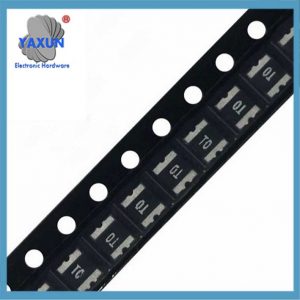 Fusible de autorecuperación del chip PPTC 1210 2Un 2,5 A 3 A 6 V 30 V 33 V 60 V SMD |
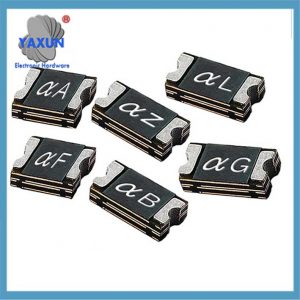 Fusible SMD reiniciable 1206 Microprocesador SMD 6V 0.35A (e0113 4c5f1 48d2a d4c5b 1f85e d0afa |
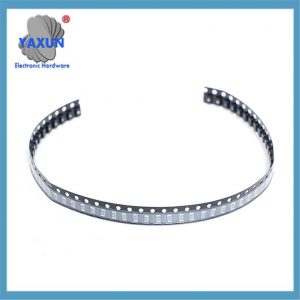 Fusible SMD Resetable 1812 16V 2A Chip de montaje de superficie para protección contra sobrecorriente de comunicación |
El fusible de chip reajustable (PPTC) Es un elemento de protección contra sobrecorriente basado en las características del coeficiente de temperatura positivo de un polímero.. Tiene una función de reinicio automático y se usa ampliamente en la protección de circuitos de equipos electrónicos.. Los siguientes son sus puntos centrales.:
1. Estructura y principio de funcionamiento.
Composición del material
Está compuesto por una resina polimérica especialmente tratada. (como polímero PE) y partículas conductoras (negro de carbón o partículas metálicas). En condiciones normales, las partículas conductoras forman un camino de baja resistencia (0.1-varios ohmios).
Mecanismo de protección
Cuando ocurre sobrecorriente, el efecto térmico de la corriente hace que la resina se derrita y se expanda, la red conductora se rompe, y la resistencia aumenta repentinamente a un estado de alta resistencia (hasta el nivel de megaohmios), limitar la corriente al nivel de microamperios.
Después de que se resuelva la falla, las partículas conductoras se enfrían y se encogen, reconectar, y volver a un estado de baja resistencia, sin necesidad de reemplazo manual.
Comportamiento PTC:
Los fusibles reajustables utilizan un coeficiente de temperatura positivo polimérico (PPTC) material. Este material presenta un aumento significativo de la resistencia a medida que aumenta la temperatura..
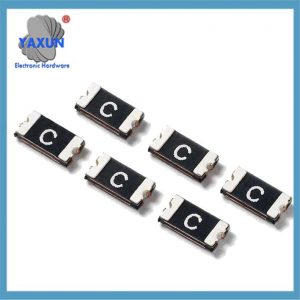 Proveedor de China de fusibles reajustables de montaje en superficie Littelfuse |
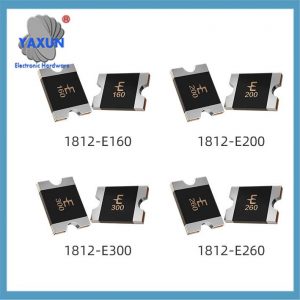 LF 1812 Fusible reiniciable PPTC 1812L SMD autorecuperación 0.2A 0.5A 500mA 0.75A 1.1A 1.5A 2A 2.6A 3A 6V 8V 13.2V 15V 24V 30V |
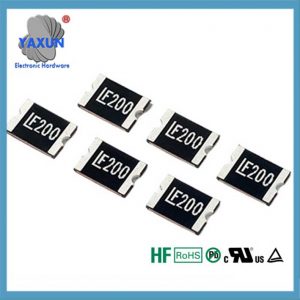 Fusible reiniciable PPTC del soporte superficial de la protección contra sobrecorriente 6V 30V 33V 60V SMD |
Protección contra sobrecorriente:
Cuando una corriente excede el valor nominal del fusible, fluye, el material PPTC se calienta, haciendo que su resistencia aumente. Este aumento de resistencia reduce el flujo de corriente., evitando daños al circuito.
Reinicio automático:
Una vez que se elimina la falla y el fusible se enfría, la resistencia disminuye, permitiendo que se reanude el flujo de corriente normal.
Características y beneficios clave:
Auto-reinicio:
La capacidad de restablecerse automáticamente después de un evento de falla lo convierte en una alternativa reutilizable a los fusibles tradicionales..
Protección contra sobrecorriente:
Protege los circuitos de daños causados por corriente excesiva., cortocircuitos, o sobrecalentamiento.
Ahorro de espacio:
El empaque SMD permite la integración en dispositivos electrónicos compactos.
Amplia gama de aplicaciones:
Encontrado en varios dispositivos., incluyendo computadoras, teléfonos móviles, equipo medico, y electrónica automotriz.
Ejemplo:
Imagine una situación en la que un puerto USB de una computadora portátil sufre un cortocircuito accidental.. Un fusible reiniciable en la línea de alimentación USB detectaría la sobrecorriente y aumentaría su resistencia., Limitar la corriente y evitar daños a la fuente de alimentación de la computadora portátil y otros componentes.. Una vez quitado el corto, el fusible se restablecería, y el puerto USB estaría listo para usar nuevamente.